

Can God Spread a Table in the Wilderness? Matthew 14:13-21

Rev. Bobby Musengwa
Transitional General Presbyter
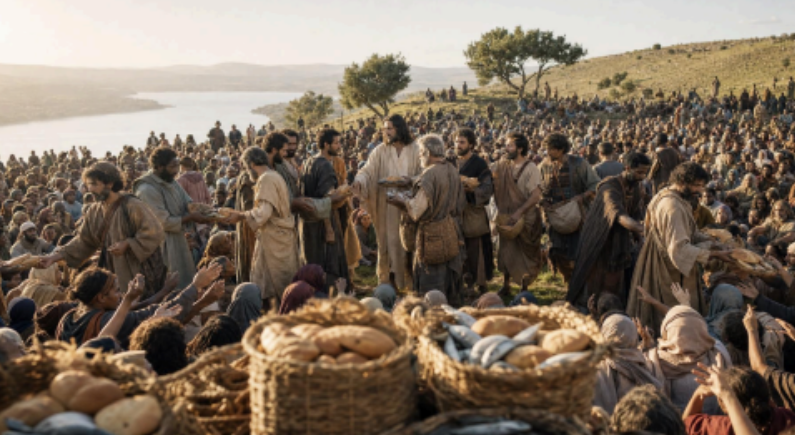
An old psalm asks a doubting question: "Can God spread a table in the wilderness?" (Psalm 78:19)
The Israelites asked it in the desert, grumbling and afraid, wondering if God had led them out of Egypt just to let them starve.
Centuries later, on a Galilean hillside, thousands of hungry people got their answer. It was yes.
A Crowd Carrying Grief
Matthew places this miracle right after gut-wrenching news.
Herod has just executed John the Baptist at a birthday party thrown to impress his guests, and John's own disciples have carried his body away and told Jesus.
Jesus withdraws by boat to a deserted place, likely seeking a moment alone to grieve his cousin.
But the crowds will not let him have that moment. Word travels fast, and thousands of people from the surrounding towns follow him on foot, arriving at that same lonely place before he does.
Matthew does not tell us why this particular crowd came looking for Jesus that day.
He simply tells us they came, hungry and needy, right into the middle of Jesus's grief.
Whatever brought them, they came with empty stomachs and no clear plan for how those stomachs would get filled in a place with no shops and no food.
GRIEF DOES NOT CLEAR A SPACE FOR ITSELF. THE NEED OF OTHERS SHOWS UP RIGHT IN THE MIDDLE OF IT ANYWAY.
Ask yourself what "deserted place" you have gone looking for lately, and what crowd found you there before you got any rest.
The Words That Gave It Away
Watch closely what Jesus does with the five loaves and two fish. He takes the bread, looks up to heaven, gives thanks, breaks it, and gives it to his disciples to distribute.
Take. Bless. Break. Give.
That pattern was not a new invention. It reflects the ordinary Jewish practice of blessing bread before a meal, language this crowd would have recognized from countless tables in their own homes and villages.
Jesus was not performing something exotic. He was doing what any Jewish host did before a meal, and God multiplied it into more than five thousand people could eat.
Professor Amy-Jill Levine, a Jewish New Testament scholar and emerita professor from Vanderbilt University, has spent years teaching Christian readers to hear the deep Jewish grammar running through Jesus's ministry.
She points out the deep contrasts between Herod’s seeming abundance yielding death and scarcity, and Jesus’ seeming scarcity yielding abundance.
Indeed, this story does not show Jesus stepping outside his own tradition to do something novel.
It shows him standing fully inside it, using the ordinary language of blessing to feed a crowd that showed up hungry and unannounced.
JESUS DID NOT NEED SPECIAL WORDS FOR A MIRACLE. HE USED THE ORDINARY WORDS OF EVERY JEWISH TABLE, AND GOD DID THE REST.
What ordinary words or practices in your own faith life might carry more power than you have given them credit for?
The Question Gets Answered
Now go back to that psalm. Psalm 78 remembers Israel's wilderness complaints in painful detail.
The people had seen God part the sea, and still they doubted whether God could feed them in the desert.
"Can God spread a table in the wilderness?" they asked, more accusation than genuine question.
God answered them with manna and quail, day after day, for forty years. On that Galilean hillside, Jesus answers the same question all over again.
He makes the people sit down on the grass, an ordinary and almost domestic detail in the middle of a miracle, and then he spreads a table right there in the wilderness.
Five thousand men, plus women and children, eat until they are full, and twelve baskets of leftovers sit on the grass as proof that the answer was never really in doubt.
GOD HAS BEEN ANSWERING THAT DOUBTING QUESTION FOR THREE THOUSAND YEARS. THE ANSWER HAS NEVER CHANGED.
Where in your life or ministry are you still asking that psalm's question instead of trusting its answer?
Hope Tough Enough for the Wilderness
Dr. Esau McCaulley, writing from within the Black church tradition, describes a kind of hope that never had the luxury of being naive.
That hope had to survive real suffering and still expect God to act, because the wilderness was not a metaphor for the people who shaped it.
That is the hope this story asks of us. Not the easy confidence of people who have never gone hungry, but the tough, tested hope of people who have learned that God spreads tables exactly where the world insists there is no food to be found.
The Confession of Belhar came out of a similarly hard wilderness.
South African Christians wrote it in the middle of apartheid, declaring that the church must be a place "where the strong helps the weak, the poor is dependent on the wealthy and members assist one another in their need."
They wrote those words while their own government tried to convince them the table would never be big enough for everyone. They trusted the psalm's answer anyway.
What This Means for Your Church
The PC(USA)'s Matthew 25 invitation calls congregations to build vital, welcoming communities while doing the hard work of confronting poverty and racism.
That work asks the same question the psalm asks. Can God spread a table wide enough for everyone the world has decided to leave out?
Every time your congregation feeds someone, welcomes someone, or makes room for someone the world calls too much trouble, you are answering that question the same way Jesus did on that hillside. Yes.
Your Move This Week
You are probably standing in some kind of wilderness right now. Maybe it is a budget shortfall. Maybe it is a tired volunteer list. Maybe it is a hard season in your own life. Maybe you are grumbling about the recent General Assembly decisions.
The desert is hot, and you are hot under the collar. You seek to blame someone, anyone, any scapegoat, so you may regain peace and tranquility. So you may satiate your hunger for vengeance.
The psalm's doubting question is an old and honest one. Most of us ask some version of it more often than we admit.
STOP ASKING WHETHER GOD CAN SPREAD A TABLE IN YOUR WILDERNESS. SIT DOWN ON THE GRASS, AND WATCH THE BASKETS FILL.
God’s table in the wilderness is big enough for all. We are invited to join God’s great big party, to sit down and feast at the table. Our main mission is to invite others to come join the joyful party and make room for them to enjoy the Lord’s feast as well.
And of course, our most appropriate response is singing with a joyful heart,
Praise God from Whom all blessings flow
Praise Him all creatures here below
Praise Him above, you heavenly host
Praise Father, Son and Holy Ghost. Amen!
That is the whole sermon this week. Everything else is commentary.
Grace and peace,
Rev. Bobby Musengwa
Transitional General Presbyter
Mission Presbytery


Comments